
What Is Ordinance or Law Coverage on a Homeowners Policy?
Ordinance or law coverage is an insurance endorsement that pays for building code upgrades required when a covered loss triggers repair or replacement of a structure. Standard homeowners dwelling coverage restores damaged property to its pre-loss condition, meaning the same materials and construction methods that existed before the damage. It does not pay for improvements mandated by codes adopted after the home was originally built.
Without an O&L endorsement, homeowners pay the full difference between old-code and current-code construction out of pocket. The endorsement has three parts. Coverage A addresses loss in value of undamaged property that must be demolished to comply with code. Coverage B covers demolition costs. Coverage C pays for the increased cost of construction to meet current standards.
When Does a Roof Replacement Trigger Code Upgrades?
A roof replacement triggers code upgrade requirements when the scope of work crosses a jurisdiction-specific threshold, typically when more than 25% to 50% of the roof covering is removed or replaced. IBC Chapter 15 and IEBC reroofing provisions set the baseline: if more than 50% of the roof covering is removed or damaged, the entire roof system must meet the current adopted code. Local DMV jurisdictions may set lower thresholds.
Common triggers during storm damage roof replacement in the DMV include a full tear-off that reveals non-compliant decking, insulation below R-20 in climate zone 4A, missing ice-and-water-shield barriers, and inadequate ventilation. The two-layer rule is another trigger. Existing codes prohibit installing over two layers, and most jurisdictions now require a full tear-off to the deck.
DC imposes cool roof requirements with a minimum Solar Reflectance Index (SRI) threshold for flat roofs, triggered during any full replacement. Maryland mandates ice barrier installation in all counties during full roof replacement. Even a straightforward hail damage roof replacement may require code upgrades that standard insurance coverage does not pay for.
Determining whether storm damage warrants a replacement-level claim is the first step. Filing for minor damage below the deductible wastes a CLUE report entry, while overlooking legitimate damage leaves insurance money uncollected. A storm damage assessment helps gauge whether damage severity reaches the threshold where O&L coverage becomes relevant.
Take the 2-Minute Storm Damage Assessment →
The Three Parts of Ordinance or Law Coverage
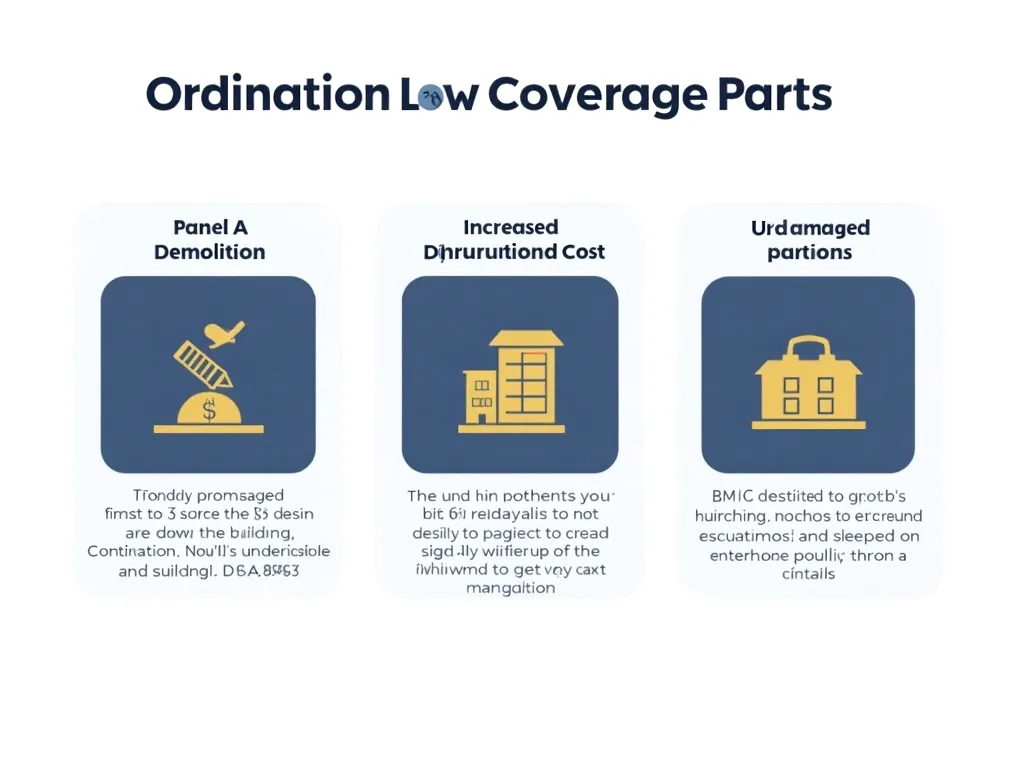
Ordinance or law insurance coverage is structured as three components, each addressing a distinct cost when building code compliance is required during a covered repair.
Coverage A — Undamaged Property Loss pays for the loss in value of the undamaged portion that must be removed to comply with code. If a storm damages 60% of a roof and building code requires the entire system to meet current standards, the remaining 40% has functional value that is forfeited. Coverage A compensates for the undamaged shingles, underlayment, and flashing that must come off during a code-mandated full tear-off.
Coverage B — Demolition Cost pays for labor and disposal costs of removing the undamaged portion: tear-off labor, hauling fees, and landfill charges beyond what the base claim covers. On a two-layer roof where code requires full removal to the deck, demolition costs for the undamaged layer may add $1,000 to $3,000.
Coverage C — Increased Cost of Construction pays the difference between rebuilding to pre-loss specifications and rebuilding to current building code standards. This covers ice barriers, insulation upgrades to current R-values, ventilation additions, and SRI-compliant materials. Coverage C is the largest out-of-pocket exposure for DMV homeowners because it absorbs every code gap between original construction and current requirements.
Most standard homeowners policies include O&L at 10% of dwelling coverage. For a home insured at $400,000, that provides $40,000, which may be enough for newer construction. For pre-2000 homes with multiple code gaps, 10% might fall short.
How Much Do Code Upgrades Add to Roof Replacement Cost?
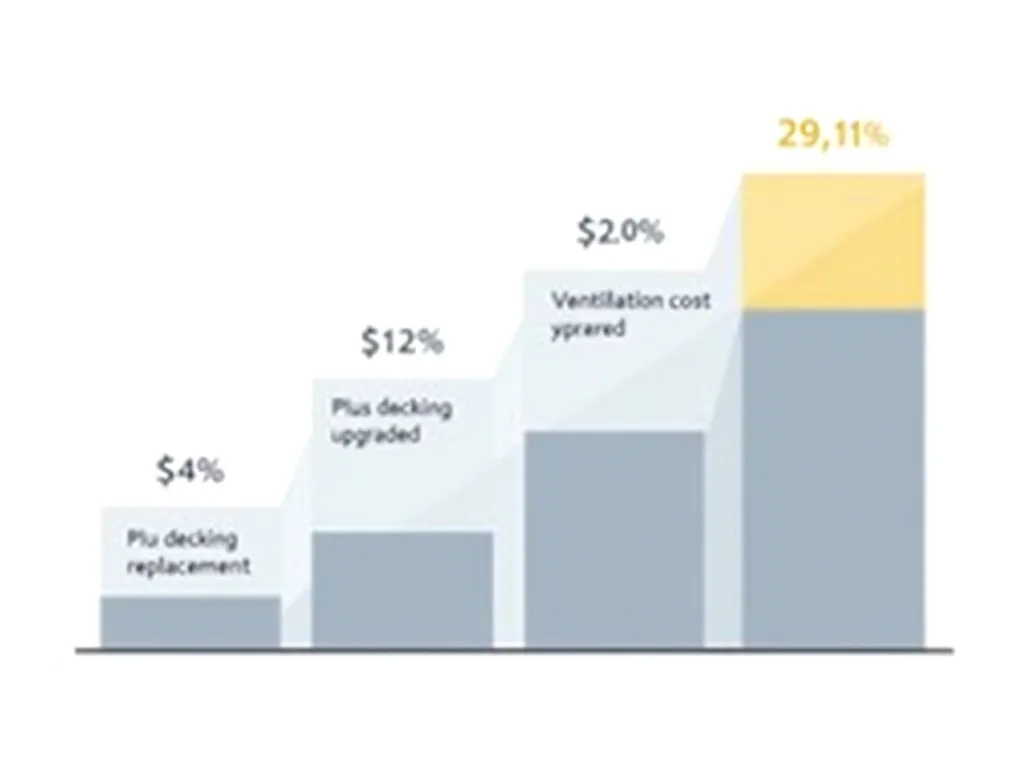
Code upgrade costs vary by the gaps between original construction and current building code. The following ranges reflect 2025-2026 contractor pricing in the DMV metro area.
Ice barrier installation (mandatory in all Maryland counties): $500 to $1,500 depending on eave length. R-20 insulation upgrades in climate zone 4A, required when decking is replaced: $1,500 to $4,000. Ventilation upgrades to current IRC requirements: $800 to $2,500. DC cool roof compliance for flat roofs (SRI-rated materials): $1,000 to $3,000 premium. Full tear-off of two existing layers when code prohibits overlay: $1,000 to $3,000.
Total code upgrade cost on a pre-2000 home may reach $3,000 to $12,000 above the base roof replacement cost. Without O&L coverage, the homeowner pays 100% of these costs, even when the underlying storm damage claim is fully approved.
The base roof replacement cost varies by roof size, pitch, and material. A Roof Replacement Cost Calculator shows the base cost for a specific roof profile and material choice. Adding the code upgrade costs above gives the total replacement cost, which is what the O&L coverage limit needs to be measured against.
Do You Have Ordinance or Law Coverage? How to Check
Ordinance or law coverage appears on the declarations page of a homeowners insurance policy as a named endorsement. It is not part of base dwelling coverage. Locate your most recent declarations page and look for an O&L endorsement with a specific coverage limit.
The limit is typically expressed as a percentage of dwelling coverage: 10%, 25%, or 50%. A 10% limit on a $350,000 policy provides $35,000 for code-related costs. The right limit depends on the home’s age and the number of code gaps likely to exist.
If no O&L endorsement appears, contact your insurance agent and request one before storm season. The cost is typically $25 to $75 per year, which is minor compared to $3,000-$12,000 in potential exposure. For homes built before 2000 with original roofing, O&L coverage is not a discretionary add-on. It addresses a near-certain cost during any future full roof replacement.
DMV-Specific Code Requirements That Trigger O&L Claims
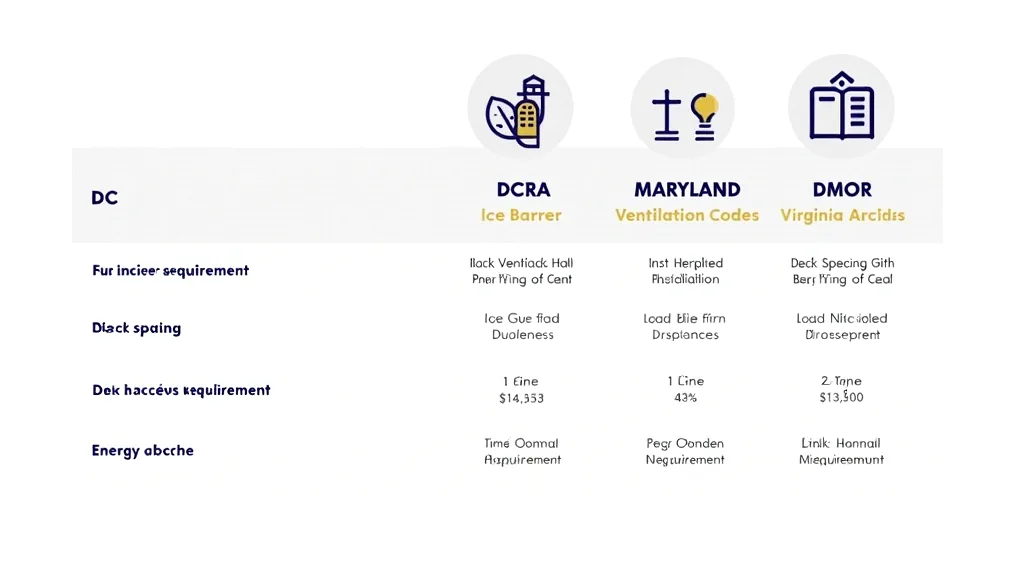
Maryland requires MHIC-licensed contractors, mandatory ice barriers in every county, and a matching rule that may require insurers to match undamaged roof sections (potentially triggering Coverage A). A two-layer maximum applies statewide with full tear-off preferred.
Virginia requires DPOR licensing. No mandatory matching rule exists at the state level. Permit requirements and ICC/IBC adoption vary by county, and some Virginia jurisdictions still operate under older code editions.
DC requires DCRA permitting for all roof work. Cool roof SRI requirements apply to flat roofs during replacement. Historic district properties face State Historic Preservation Office review, which may impose material restrictions that increase costs. Minimum slope requirements add another compliance layer.
DC carries the highest O&L exposure among the three jurisdictions due to cool roof mandates plus historic district overlay. Building code requirements for roof slope standards, insulation R-values, and SRI thresholds differ significantly across these jurisdictions. A detailed breakdown of Roofing Building Code Requirements DC, MD & VA covers each jurisdiction’s current standards and how they affect replacement scope and cost.
Frequently Asked Questions
Does homeowners insurance cover building code upgrades? Standard dwelling coverage does not. Only a separate ordinance or law endorsement pays the cost difference between restoring a roof to pre-loss condition and rebuilding to current code.
Can an insurance company deny a code upgrade claim? An insurer may deny a code upgrade claim if the policy lacks an O&L endorsement or the upgrade is not triggered by a covered loss. Upgrades required during routine maintenance or elective renovation fall outside O&L coverage.
What if my roof doesn’t meet current code after storm damage? A roof that does not meet current building code must be upgraded during replacement. Local building departments will not issue a permit for non-compliant work. O&L coverage pays the difference between old-code and current-code costs, provided the endorsement is active at the time of loss.
O&L coverage only activates when the underlying dwelling coverage first covers a qualifying loss. Homeowners insurance must cover the storm damage itself before ordinance or law coverage addresses the code upgrade costs that follow. Understanding both base storm damage coverage and the O&L endorsement determines a homeowner’s full financial exposure after a hail or wind event. For a complete overview, see Does Homeowners Insurance Cover Storm Damage?