
Calculate Your Roof Replacement Cost in the DMV
A roof replacement in DC, Maryland, and Virginia runs anywhere from $8,500 to $25,000 or more. That range is wide enough to be almost useless without your specific details. The final number depends on your roof’s square footage, the roofing materials you choose, the pitch of your roof, how many existing layers need to come off, and which jurisdiction you are in, because permit fees and labor rates vary significantly across the DMV.
This calculator uses 2026 regional pricing for the DMV area, including current labor rates, material costs, tear-off and disposal fees, and permit costs for Maryland, Virginia, and Washington DC. Enter your roof details and get an instant estimate broken down by category.
Interactive tool loads here
inline-cost-calculator
What Affects Your Roof Replacement Cost

Knowing what drives the final number helps you tell whether a contractor’s quote or an adjuster’s estimate is in the right ballpark.
Roof size. Roofing is measured in squares — one roofing square equals 100 square feet. A typical single-family home in the DMV has a roof area of 1,500 to 3,000 square feet (15 to 30 squares). Your roof area is larger than your home’s floor plan because it includes the overhangs, and steep roofs have more surface area than the same footprint with a lower pitch.
Material choice. This is the single biggest cost variable homeowners control. Standard three-tab asphalt shingles run $4 to $7 per square foot installed in the DMV. Architectural (dimensional) shingles cost $5 to $9 per square foot and last significantly longer. Metal roofing runs $9 to $16 per square foot. Impact-resistant Class 4 shingles — designed to withstand hail — fall in the $6 to $10 range and may qualify for insurance premium discounts of 10 to 25 percent.
Roof pitch and steepness. Steeper roofs cost more because they require additional safety equipment, slow down the work pace, and increase the amount of roofing materials needed per square foot of floor plan. A roof with a 12/12 pitch (45 degrees) can cost 20 to 30 percent more than the same home with a standard 4/12 pitch.
Tear-off layers. If your current roof has one layer of shingles, the tear-off is standard. If a previous reroofing job added a second layer over the original, both layers must come off — building codes across Maryland, Virginia, and DC prohibit installing over two layers, and most codes now require full tear-off to one layer. A two-layer tear-off adds $1,000 to $3,000 to the project.
Permit requirements. Permit fees and processes vary by jurisdiction. Maryland counties typically charge $75 to $250 for a roofing permit. Virginia permit fees range from $100 to $350. Washington DC charges $150 to $500 depending on project scope, and projects in historic districts require additional review by the State Historic Preservation Office.
Structural repairs. If the decking beneath your shingles has rotted or taken water damage, it has to be replaced before new roofing goes on. Decking replacement adds $2 to $5 per square foot for the affected area. This is one of the costs that online calculators cannot predict — it only becomes apparent once the old roofing comes off.
DMV labor rates. Roofing labor in the DMV runs 15 to 25 percent above the national average, with Washington DC at the top (20 to 30 percent above national) and outer suburbs like Fredericksburg and Waldorf closer to the national median. Labor is typically 40 to 60 percent of the total project cost.
Roof Replacement Cost by Material (2026 DMV Prices)
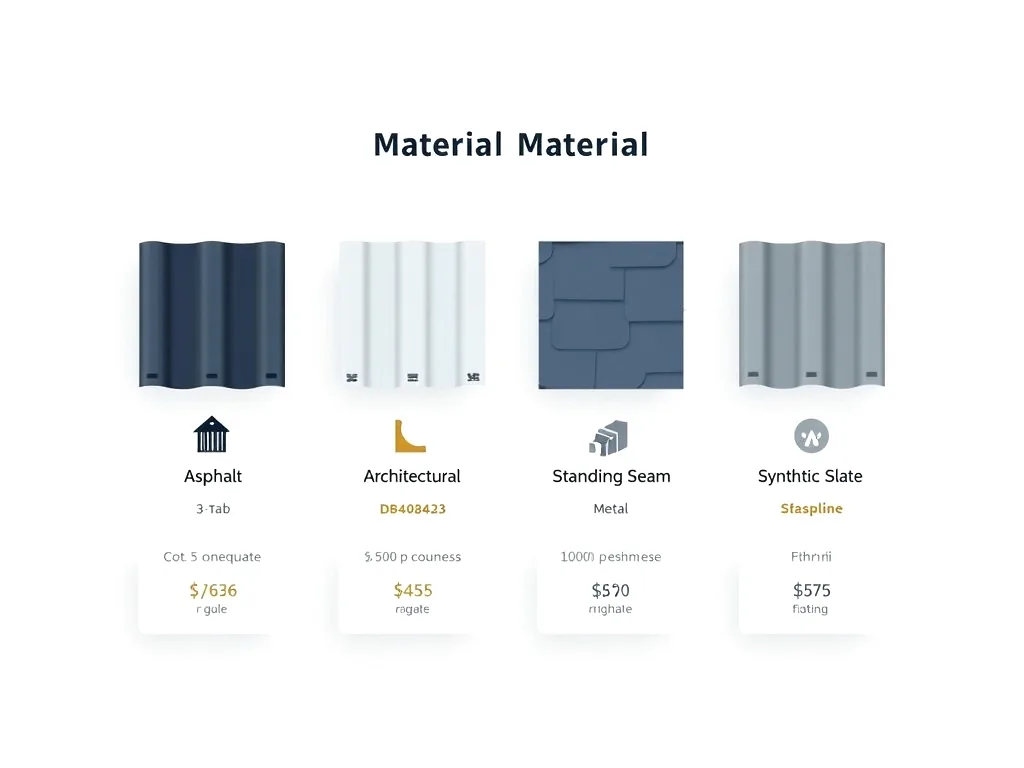
These are installed costs for a typical 2,000-square-foot roof in the DMV area, including labor, materials, tear-off of one existing layer, and standard permits.
3-tab asphalt shingles: $5,500 to $9,500. The most affordable option. Three-tab shingles have a flat, uniform appearance and a typical lifespan of 15 to 20 years. They are adequate but offer less wind resistance and a shorter warranty than architectural shingles.
Architectural (dimensional) shingles: $7,500 to $14,000. The most popular choice for DMV homeowners. Architectural shingles are thicker, more wind-resistant (rated to 110-130 mph), and carry 30- to 50-year manufacturer warranties. Most insurance claims for storm damage cover architectural shingles as the replacement standard.
Impact-resistant Class 4 shingles: $9,000 to $16,000. Tested to the UL 2218 standard, these shingles withstand two-inch hail without functional damage. They cost more upfront but may reduce homeowners insurance premiums by 10 to 25 percent — a savings that compounds over the roof’s life. For homeowners in the DMV hail corridor, Class 4 shingles are increasingly the smart long-term choice.
Standing seam metal: $15,000 to $30,000. The premium option. Metal roofs last 40 to 60 years, resist hail and wind damage far better than asphalt, and carry the highest resale value. The upfront cost is two to three times higher than architectural shingles, but the lifecycle cost per year is often lower.
A storm damage insurance claim can be a chance to upgrade your roofing materials. If your existing three-tab shingles sustained hail damage and the claim covers a full replacement, the insurance payout covers the cost of like-kind replacement (the same material that was damaged). Homeowners often pay the difference out of pocket to upgrade to architectural or Class 4 shingles, which costs less than the full price difference because labor and tear-off are already covered by the claim.
Costs vary meaningfully by jurisdiction across the DMV. Maryland’s MHIC licensing rules, mandatory ice barrier code, and insurance matching rule — which requires insurers to match materials on undamaged roof sections — all affect the final price homeowners pay for storm damage roof replacement. See Roof Replacement Costs in Maryland for state-specific pricing, regulations, and contractor requirements.
Virginia’s DPOR licensing structure and the absence of a mandatory matching rule create different cost dynamics than neighboring Maryland. Labor rates in Northern Virginia run higher than the state average, but areas like Fredericksburg and Woodbridge offer more competitive pricing. Permit processes vary by county, affecting both timeline and total project cost. See Roof Replacement Costs in Virginia for Virginia-specific details.
Washington DC carries the highest labor costs in the DMV — 20 to 30 percent above the national average — and has requirements that do not exist in Maryland or Virginia, including cool roof standards mandating minimum Solar Reflectance Index values and historic district preservation rules enforced by the DCRA and State Historic Preservation Office. DC’s mix of flat rowhouse roofs and historic slate adds complexity that most national calculators miss entirely. See Roof Replacement Costs in Washington DC for DC-specific pricing and regulatory details.
Does Insurance Cover Roof Replacement After Storm Damage?
Most homeowners insurance policies in the DMV cover storm damage roof replacement, but the fine print in your coverage makes a real difference in what you pay out of pocket.
Replacement Cost Value (RCV) vs. Actual Cash Value (ACV). RCV policies pay what it costs to replace your roof with equivalent materials at current prices, minus your deductible. ACV policies depreciate the payout based on your roof’s age — a 15-year-old roof might receive 50 percent less than the actual replacement cost. The difference between RCV and ACV can mean tens of thousands of dollars on a roof replacement claim. Homeowners with older roofs especially need to understand whether their policy depreciates the payout and whether cosmetic damage exclusions apply to their hail damage. Does Homeowners Insurance Cover Storm Damage? explains coverage types, exclusions, and jurisdiction-specific rules for MD, VA, and DC.
Depreciation holdback. Even with an RCV policy, insurers typically pay in two installments. The first check covers the ACV amount. After you complete the replacement using the full estimated amount, you file for the depreciation holdback — the difference between ACV and RCV — and the insurer releases the remainder.
The 25 percent rule. When 25 percent or more of a roof is damaged, most adjusters approve full replacement instead of patching. This is not a law. It is an industry guideline, because patching more than a quarter of a roof surface just does not hold up well.
Get your own estimate first. Having a detailed, line-item estimate from an independent contractor before the insurance adjuster visits gives you a benchmark. If the adjuster’s Xactimate estimate comes in lower, you have specific line items to challenge in a supplement request.
Frequently Asked Questions
What is the 25% rule in roofing? The 25 percent rule is an industry guideline, not a legal requirement. When storm damage affects 25 percent or more of a roof’s surface area, most insurance adjusters approve full roof replacement rather than partial repair. The rationale is that patching more than a quarter of the roof creates color mismatches, potential installation issues at transition points, and does not meaningfully extend the roof’s remaining lifespan.
How much is 1,500 sq ft of shingles? For a 1,500-square-foot roof in the DMV, expect to pay $4,000 to $7,000 for three-tab asphalt shingles or $5,500 to $10,500 for architectural shingles, installed. These ranges include labor, materials, basic tear-off, and standard permit fees but do not account for steep pitch, multiple layers, or structural repairs.
How to calculate the cost to replace a roof? Multiply your roof area (in square feet) by the installed cost per square foot for your chosen material. Add permit fees ($75 to $500 depending on jurisdiction), tear-off costs if more than one layer exists ($1,000 to $3,000), and budget 10 to 15 percent for contingencies like decking repair. For a more precise estimate, use the calculator above with your specific roof dimensions and material preferences.
Does a 25-year-old roof need to be replaced? Not necessarily, but a 25-year-old asphalt shingle roof is at or past its expected lifespan and is far more vulnerable to storm damage than a newer roof. If your roof is 25 years old and shows signs of wear — curling shingles, widespread granule loss, cracked flashings — a storm event is likely to push it past the point of economical repair. Some insurers will not renew policies on roofs over 20 years old without a professional inspection confirming the roof’s condition.

Get an Accurate Quote for Your Roof
Online calculators, including this one, give you estimates based on regional averages and the numbers you plug in. They cannot catch the hidden stuff that only shows up once someone is on the roof: decking rot hiding under intact shingles, ventilation problems that void manufacturer warranties, flashing failures at valleys and penetrations, or code upgrades your jurisdiction requires during a full replacement.
A professional inspection gives you a line-item estimate you can hold up against the adjuster’s Xactimate numbers. If there is a gap, the contractor’s documentation is what you need to file a supplement.
Free storm damage inspections in the DMV include full measurement, material assessment, photographic documentation, and a written estimate. If storm damage is involved, the inspection also produces the insurance claim documentation you need to file effectively. Get a Free Inspection — no obligation, licensed and insured DMV contractors, same-week availability.
Not sure about your results?
Get a free professional inspection from a licensed DMV contractor. Same-week availability.
Schedule Your Free Inspection
Licensed contractors. No obligation. Same-week availability.
No spam. Your information is shared only with a licensed DMV roofing contractor.